
Insurance Commission Software Costs: What to Include in Your Budget
Automate Your Commission Process
GreenWave Newsletter
Smarter strategies to simplify commissions, eliminate errors, and stay in control.
Commission Management Secrets
Find $100K+ Hiding in Your Commission Process.
More than a quarter of organizations that implemented new enterprise software went over their project budgets, according to Panorama Consulting’s 2026 ERP Report, and the leading cause was additional technology nobody had accounted for.
Commission software budgets go wrong the same way.
The subscription line gets all the attention during evaluation, and it is rarely the biggest number in year one, because carrier formats have to be mapped, history has to be moved, and your commission manager spends weeks testing a parallel cycle while still running the real one.
What follows are the categories that belong in a first-year commission software budget, including the ones no vendor quote will show you, and a way to put a defensible dollar figure on your own team’s time.
Price The Operation, Not The Product
Vendors in this market quote against scope rather than publishing a price list, and the reason is structural. A BGA running three entities across forty carriers with a layered producer hierarchy is buying something different from an agency with one entity and six carriers.
Before you ask anyone for a number, write down the facts that drive the work:
- Legal entities, and the lines and states they write
- Carriers you are contracted with, and how each one delivers its statements
- Statement and transaction volume in a typical month
- Producers and downlines you pay, and the number of distinct compensation arrangements behind them
- Named users by role, including people who only need to view reports
- Systems that need to exchange data with the platform, such as your accounting system and your agency management system
- Whether you want software your team runs, or software plus a team that does the processing
Send the same description to every vendor you are considering. Two quotes built on different assumptions are not comparable, however similar the subscription lines look.
Ask For Every Quote In Two Columns
Recurring costs are the ones that return next year: the platform fee, support, anything priced per user or per volume tier, and a service fee if processing support is in scope.
One-time costs cover getting into production, which means implementation and configuration, carrier setup and statement mapping, data migration, integrations, and training.
Two questions decide whether those columns hold up. Ask whether carrier setup sits inside the implementation fee or is billed per carrier, because that answer moves the total for anyone planning to add carriers next year. Then ask what changes the recurring figure later, whether that is a new entity, a volume tier or additional users.
Get the triggers in writing before you sign. The U.S. Government Accountability Office, the agency that audits federal spending, publishes a cost estimating guide built on the same principle: an estimate is credible only when it documents its ground rules and assumptions, so a reader can see what was counted and what was left out. Hold the proposal in front of you to that test.
Put A Real Number On Your Own Team’s Hours
This is the line most commission software budgets leave out, and it is rarely small.
Start with a loaded hourly rate rather than a salary. The Bureau of Labor Statistics puts the median wage for insurance claims and policy processing clerks at $23.67 an hour as of May 2025. Wages make up roughly 70 percent of what an employer actually spends per hour worked, with benefits accounting for the rest, according to the BLS, so the true cost of that hour sits closer to $34.
Now count the hours. Someone has to pull and clean current data, answer configuration questions, test a parallel cycle, review output before anyone gets paid, and own exceptions after go-live. As an illustration, three people giving ten hours a week across a twelve-week implementation comes to 360 hours, or roughly $12,000 of internal cost that appears on no quote. Your own numbers will be different, but the arithmetic is the same, and the result belongs in the budget you present.
Then add a contingency line. Money set aside at the outset is a budget decision, while the same money found in month seven becomes a conversation about your credibility.
Software And Processing Support Are Two Different Purchases
Comparing subscription against subscription breaks down the moment one offer includes labor and the other does not.
With software alone, your team keeps loading statements, researching exceptions, chasing carriers and approving payouts, while the platform makes that work faster and easier to trace. With processing support, part of that work moves to a vendor, and the cost shifts out of internal hours into a service fee.
Price both the same way, as vendor fees plus the hours you keep at the loaded rate above. An offer that costs more per month can cost less per year when it absorbs work you were about to hire for, which is the arithmetic behind reducing cycle time without adding headcount.
Build A First-Year Number You Can Defend
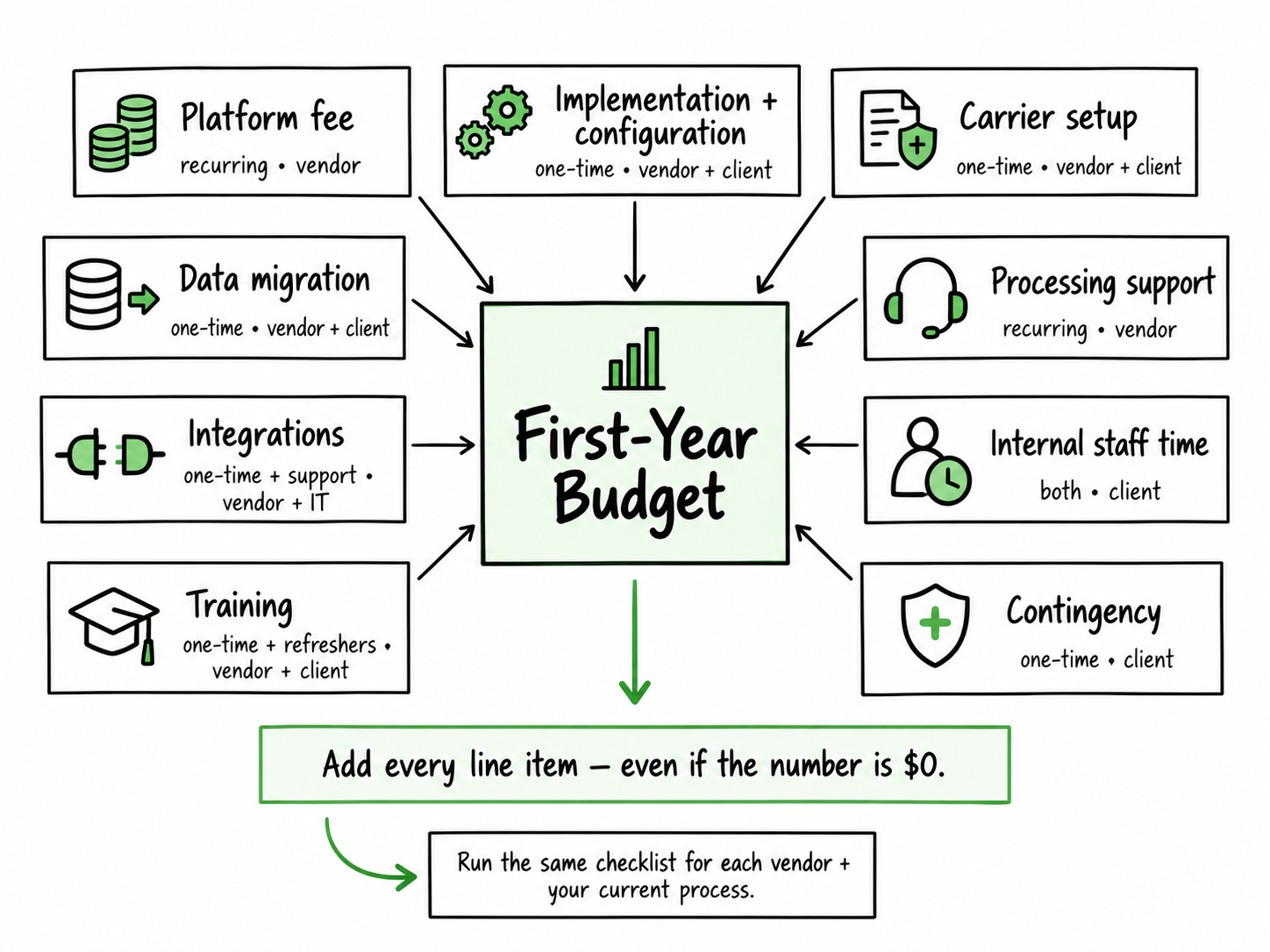
Put an amount against every line below, including the ones that come back as zero. The entries in brackets are whether the cost repeats and who carries it.
- Platform fee (recurring, vendor): access for named users at the agreed volume.
- Implementation and configuration (one-time, vendor and client): setup, compensation rules, testing.
- Carrier setup (one-time, vendor and client): statement formats and identifier mapping for each carrier.
- Data migration (one-time, vendor and client): the history that has to be live in the new system.
- Integrations (one-time, with support after, vendor and IT): accounting, agency management, reporting.
- Training (one-time, with refreshers, vendor and client): analysts, approvers, finance, producers.
- Processing support (recurring, vendor): work the vendor performs instead of your team.
- Internal staff time (both, client): the hours you counted above, priced at a loaded rate.
- Contingency (one-time, client): an agreed percentage for scope found during implementation.
Run the list for every vendor on the shortlist, then price what you spend today the same way. Current spend includes your existing tools, the hours your team gives to manual reconciliation, and the payout corrections you absorb each quarter. The new system is not free, and neither is the one you have.
What to bring to the conversation
A vendor can give you a number worth comparing once you arrive with the operating facts. Bring your entity and carrier list, a recent month’s statement and transaction volume, a count of producers and compensation arrangements, your user list by role, the systems that need to connect, and your own hour estimate priced at a loaded rate.
Timing deserves the same attention as scope, which is why summer is usually a better implementation window than the quarter your team spends closing the year.
Bring that list and book a call. We will work through these categories against your setup, so the number you take back to your leadership team is one you can defend.
GreenWave Newsletter
Get practical insights, smarter workflow ideas, and helpful strategies designed to make commission management clearer, more efficient, and easier to control.

Commission Management Secrets
Our concise guide will help you maximize profitability, speed and precision in your business’ commission management process.