
How Automation Supports Rapid Agent Onboarding
Automate Your Commission Process
Discover how we can help your business save money!
GreenWave Newsletter
Smarter strategies to simplify commissions, eliminate errors, and stay in control.
Commission Management Secrets
Find $100K+ Hiding in Your Commission Process.
Let me be blunt about something most BGAs get wrong.
You might think onboarding is finished when the producer is appointed. The producer thinks onboarding is finished when the first commission check hits the bank and the number is right.
Only one of you is correct…and it’s not you.
Every fall, agencies pour money and hours into recruiting. New producers, new downline agencies, everybody signed and ready before the Q4 rush. And then the first statement goes out late, or at the wrong level, or with an override missing, and the relationship you just paid to build starts with an apology.
That is not a paperwork problem. That is a process problem. And it is fixable, starting today.
Onboarding has two halves. You only control one.
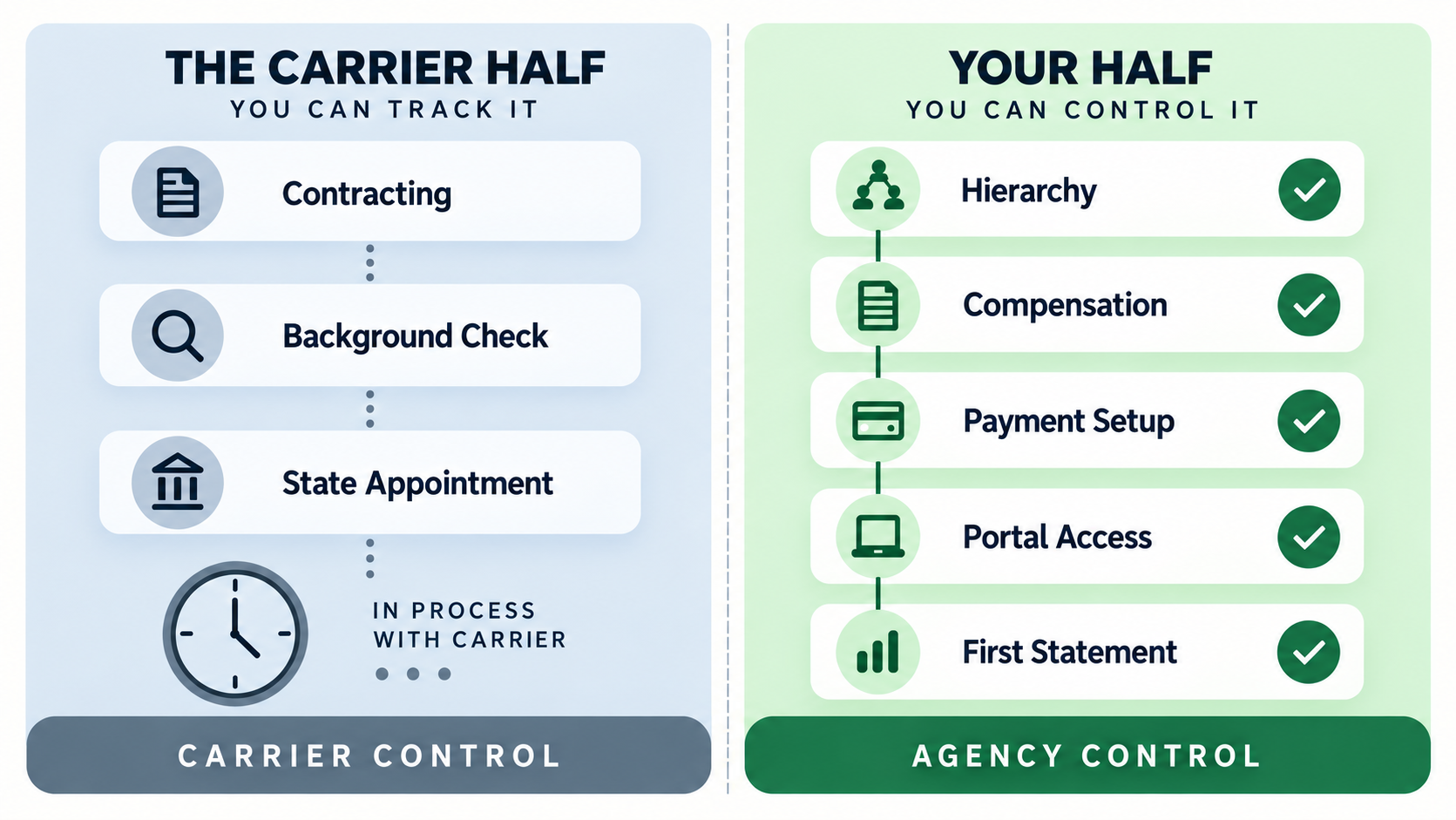
Here is the split nobody explains to a new principal.
👉 The first half belongs to the carriers.
Contracting paperwork, background checks, and state appointments. You do not submit the appointment. The carrier does. In South Carolina, for example, appointments must be submitted by the appointing insurance company, electronically through NIPR, and cannot even be requested until the producer holds an active license. Most states work the same way. Licensing and compliance vendors report that carriers commonly take two to three weeks to fully onboard a producer, and often quote weeks or months to process state appointments.
You can chase. You can track. You cannot force the clock.
👉 The second half belongs to YOU.
Placing the producer in the hierarchy. Setting the contract level for each carrier. Recording the overrides above them and any special deal you agreed to. Capturing payment method and tax details. Giving them portal access. And the one that matters most: making sure the first carrier statement line that carries their name lands on them and pays correctly.
No carrier decides how fast this half moves. No state. Just your agency, your process, and your system.
So when a producer sits in limbo for three weeks, look at which half caused it. My experience says the agency half is guilty far more often than anyone admits.
What “Commission-Ready” Actually Means
Stop using the word “onboarded.” It hides the ball. Use “commission-ready” instead, and define it like this. A producer is commission-ready when:
- They exist in your commission system under the EXACT name the carriers will print on statements.
- They are placed under the right upline, at the right contract level, for every carrier they will write.
- Their compensation arrangement is recorded in full: level, overrides, special deals, advance or as-earned.
- Their EFT and W-9 are on file.
- They can log into a portal and see their own statements without calling your office.
- Their first statement line matches to them automatically and validates against the arrangement you recorded.
If all six are true, onboarding is done. If any one is false, you’re not done with onboarding – no matter how many appointments have cleared.
Where Manual Onboarding Breaks, Every Single Time
I have watched the same failures play out across agencies of every size. They are boring, predictable, and each one shows up on the first payment.
The producer is set up at the wrong level, because the person entering it read the contract quickly.
The upline link is missing, so the overrides do not flow, and the downline agency principal calls asking why.
A special deal was agreed on the phone in August and lives in an email nobody opens in November.
The producer’s name is spelled one way in your system and another way on the carrier statement, so every line they earn goes to held and sits there.
The first statement is built by hand, under Q4 pressure, by someone who also has forty other statements to build.
None of these happen because you have “bad” people. They are caused by a manual process and the pressure of a busy month.
What Automation Changes, Specifically
I am not going to tell you automation makes onboarding “faster” and leave it there. That is a brochure word. Speed comes from REMOVING steps, and here are the steps that go away.
You set the producer up once. Their hierarchy position and compensation arrangement become the single source of truth for every carrier, so there is no re-entry per carrier and no drift between them.
When the first carrier statement arrives, the line matches to the producer automatically. No hunting, no held queue for a spelling mismatch, because the system already knows what the carrier calls them.
The matched line validates against the recorded arrangement. If the carrier paid at the wrong rate, or your setup has a wrong level, the discrepancy is flagged before money moves, not after the producer notices.
The statement is generated and delivered to the portal without anyone building it in Word.
This is what a highly effective commission process looks like on day one of a producer’s relationship with you. It is the core of what we built GreenWave to do: hold the hierarchy and the deal once, match and validate every line against it, and get statements out without manual assembly. The result is a producer who is paid correctly the first time, in a busy month, without heroics from your team.
Why The First Statement Matters More Than The Welcome Kit
Now the part principals do not like to hear.
According to LIMRA, as reported by AM Best, only 15 of every 100 recruits are still with the company that hired them four years later. Fifteen. You are spending real money recruiting people who, statistically, mostly leave.
Most of the reasons are outside your control. Prospecting dries up. The business is hard. Life happens. LIMRA’s own retention research describes the first year as the steepest drop, when a new agent runs through their natural market and income stalls.
But one thing is entirely inside your control, and it lands in the first thirty days. Paying the producer correctly, on time, with a statement they can read and trust.
I am not claiming a clean first statement fixes retention by itself. I am claiming it is one of the very few retention levers you actually own, and most agencies leave it to chance. A producer who is paid wrong in month one does not need a second reason to look at another BGA. You have already given them the first one.
Downline Agencies: Same Process, Higher Stakes
Bringing on a downline agency is onboarding multiplied. Their principal, their producers, their internal levels, all sitting under your hierarchy and all expecting overrides to flow correctly from the first statement.
Manual setup of a ten-producer downline is ten chances to get a level wrong and one very unhappy principal when it happens. Automated setup with a hierarchy template is one setup, checked once, applied to everyone. If you plan to grow through downlines this year, this is not optional. It is the difference between adding an agency and adding an argument.
The Commission-Ready Checklist
Hand this to your contracting team. Print it if you have to.
- Producer created under the exact name that carriers will use on statements.
- Placed under the correct upline at the correct contract level, per carrier.
- Compensation arrangement recorded: level, overrides, special deals, advance or as-earned.
- EFT details and W-9 on file.
- Portal login issued and tested.
- Appointment status tracked per carrier, with an owner.
- First statement line matched and validated before the first payment.
- Producer told, in writing, when and how they will be paid.
Eight lines. Check every one before you call anybody “onboarded.”
The Producer You Recruit Is The Producer You Pay Correctly The First Time
Recruiting gets the producer in the door. The first commission statement decides whether they trust you. Everything between those two points is either a process you control or a delay you’ve agreed to tolerate.
Build the second half of onboarding so it runs without heroics. Set up once, match automatically, validate before money moves, deliver without a manual build. Do that, and the producers you worked hard to recruit this fall will be writing business in Q4 instead of waiting on a statement.
GreenWave Newsletter
Get practical insights, smarter workflow ideas, and helpful strategies designed to make commission management clearer, more efficient, and easier to control.

Commission Management Secrets
Our concise guide will help you maximize profitability, speed and precision in your business’ commission management process.