
DI & LTC Quietly Bleeding Your Commission Operation (And Why Nobody Wants to Touch These Product Lines)
Automate Your Commission Process
GreenWave Newsletter
Smarter strategies to simplify commissions, eliminate errors, and stay in control.
Commission Management Secrets
Find $100K+ Hiding in Your Commission Process.
A clawback lands on an LTC policy sold three years ago. The producer who sold it has moved on. The person who reconciled it originally? Gone. And now your team is spending Thursday afternoon reconstructing a story nobody remembers – for the fourth time this quarter.

That’s not bad luck. That’s disability and long-term care commissions doing exactly what they do when the workflow around them is generic.
Here’s the truth most commission operations won’t say out loud: efficiency is not one-size-fits-all. Complexity is not evenly distributed across your product lines.
It concentrates:
- in different comp rules
- longer renewal tails
- nastier chargeback exposure
- messier carrier statements
- and more producer questions than any other line on your books.
And wherever complexity concentrates, rework accumulates. Quietly. Every cycle.
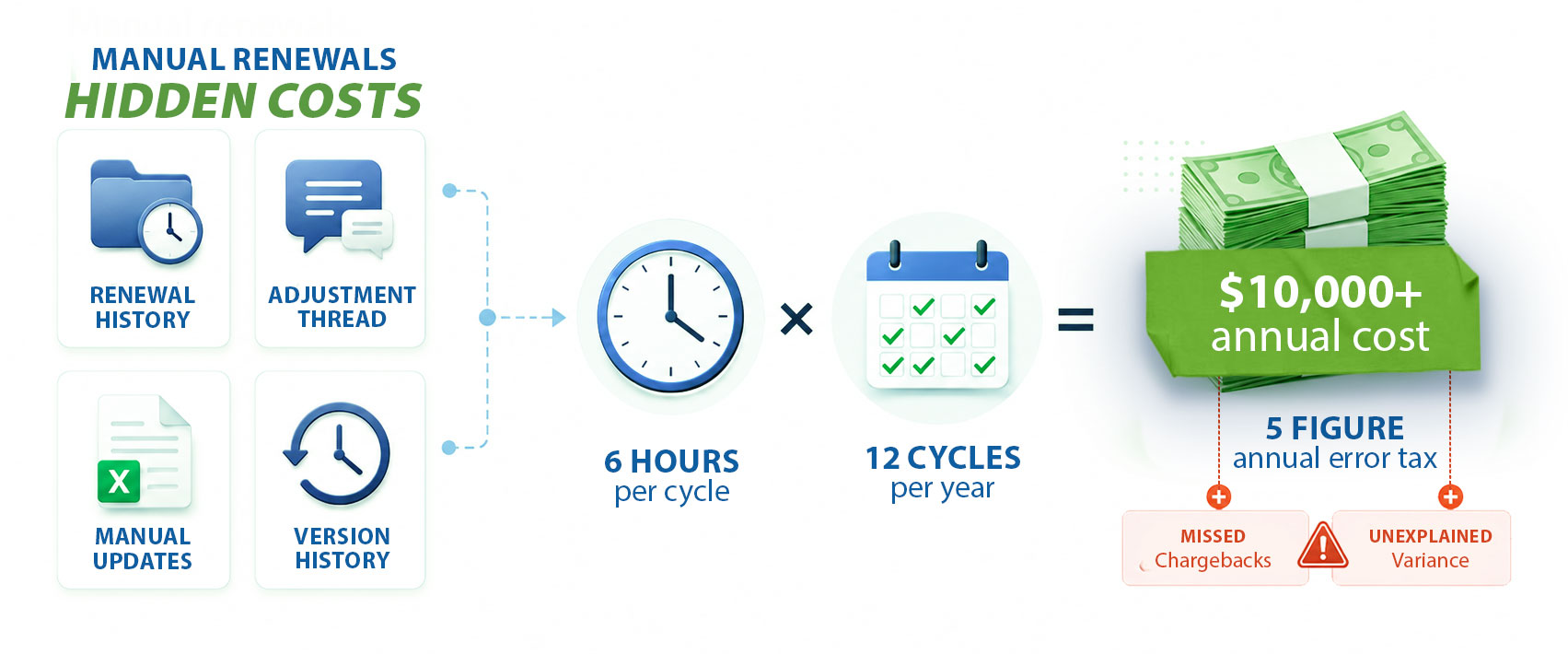
Do the math on it. If your team burns six hours a cycle rebuilding renewal history and chasing adjustment threads on these two lines alone, that’s a five-figure error tax every year – before you count a single missed chargeback or an unexplained variance Finance had to eat.
First – Take the Straight Test:
Before the five considerations, run these seven questions against your disability and LTC workflows. Answer honestly. Nobody’s watching.
- uAre product-specific rules documented and consistently applied – or remembered?
- uCan renewals and trails be traced clearly back to the originating policy?
- uAre chargebacks and clawbacks tied to the original record, even when they hit years later?
- uCan the team separate timing differences from true exceptions?
- uAre carrier statement formats normalized before reconciliation begins?
- uCan producer questions be answered without rebuilding history from memory?
- uCan Finance see a clear explanation of adjustments and variance?
A “no” doesn’t mean the product line is too hard. It means the workflow around it is too loose. The five considerations below show you exactly where.
WHY DO THESE 2 LINES
Deserve Special Attention?
More complex products naturally create more operational work. Period.
When a line has more moving parts, your team is managing far more than a payout calculation: product-specific schedules, first-year versus renewal differences, hierarchy rules, splits, carrier-specific statement formats, chargebacks, terminations, and timing gaps between expected and actual compensation.
Controlled, those details are manageable. Living in spreadsheets, memory, and disconnected notes, they’re a recurring tax on every reconciliation cycle – and disability and LTC generate more of them than nearly anything else you sell.
CONSIDERATION #1
Product-Specific Rules
Disability and LTC compensation doesn’t behave like your other lines.
Generic workflows miss the nuance every single cycle – and the moment your team has to remember which rule applies, which carrier uses which format, or how a specific renewal gets handled, you’re running on tribal knowledge.
Simply remembering the rules isn’t enough. It’s whether the process can apply and defend the rule without manual interpretation. A strong workflow makes rules easy to maintain and consistent to apply – so the answer survives the departure of the one person who currently carries it around in her head.
CONSIDERATION #2
Document the Handoff That Lives in Someone’s Head
This is where these lines get genuinely difficult.
A renewal or trail payment may not be tied to a new sale at all – it may relate to:
- an existing policy
- prior-period activity
- a status change
- or carrier renewal timing that maps to nothing in the original record.
Disability and LTC trails run for years. The reconciliation challenge doesn’t end when the policy is sold. It begins there.
The practical test is Expected → Actual → Deposit.
- Can you trace the payment back to the originating policy?
- Can you explain why it changed?
- Can you tell a timing difference from missing compensation, an adjustment from a true exception?
If not, renewal tracking will keep generating rework – quietly, cycle after cycle, for as long as those trails keep paying.
CONSIDERATION #3
Chargebacks and Clawbacks
These lines create more adjustment activity over time:
- chargebacks
- clawbacks
- cancellations
- corrections.
LTC in particular carries chargeback exposure years past the original sale, which means the adjustment arrives long after the context has faded from everyone’s memory.
What creates operational risk isn’t the adjustment itself. It’s losing the thread.
- What changed?
- When?
- Which statement reflected it?
- Was the producer impact explained?
- Did Finance get proper close support?
Track adjustments manually and your team solves the same problem three times – once in Ops, once in Finance, once in producer support.
A controlled process keeps the adjustment tied to the original record, so a clawback that hits in two years still arrives with a story attached.
CONSIDERATION #4
Carrier Statement Variability
Every carrier presents product data, producer data, policy details, and payment activity differently – and on complex lines, that variability compounds.
Your team interprets fields, normalizes data, and matches it to internal rules before reconciliation can even start.
That’s why statement intake and normalization matter most on these lines specifically. The messier the incoming data, the more critical the controlled workflow behind it – because the alternative is manual interpretation, repeated every cycle, by whoever happens to know how that carrier formats its disability statements.
CONSIDERATION #5
Producer Questions
Complex lines generate more producer questions:
- Why did this renewal pay differently?
- Why the adjustment?
- Was this policy included?
- When’s the next trail payment?
- Was the chargeback applied correctly?
Fair questions, every one. But if your team rebuilds the answer manually each time, product complexity becomes support complexity – and support complexity scales with the book.
Traceable data answers in minutes what memory reconstructs in hours, and keeps support load from growing in lockstep with every complex policy you add.
EFFICIENCY REQUIRES SPECIFICITY
The more complex the product, the more dangerous generic process control becomes. Disability and LTC commissions aren’t mysterious. They’re workflows with specific rules, specific data needs, and specific exception patterns – and they reward the operations that treat them that way.
That’s how you cut rework without pretending every line behaves the same. And it’s how the lines generating the most friction stop being the ones nobody wants to touch.
BOOK A CALL
Commission Leak Check
If disability, LTC, or other complex lines are creating tracking or reconciliation drag, book a Commission Leak Check now – before fall volume hits and you’re paying the error tax at its highest rate.
Here’s what you leave with:
- Your error tax estimated — the renewal-tracking rework, chargeback thread-loss, and product-specific support load your current workflow generates, sized in hours and dollars for your operation.
- Your top 3 leak sources identified — Identify the top three places your workflow is leaking time and money.
- A fix-first plan — the highest-leverage control to add before fall volume, with an example of what a traceable workflow produces: renewal-to-origin trace + Expected → Actual → Deposit record + adjustment history tied to the policy.
If we’re not a fit – or we can’t spot a meaningful leak quickly – we’ll tell you. You’ll still leave knowing what to fix first.
Not ready to book? Run the seven-question straight test against your own workflows. Two or more uncomfortable answers? That’s where control goes first.
P.S. The clawback that shows up in 2028 on a policy sold in 2026 doesn’t care whether anyone remembers the sale. Book the Leak Check before fall volume and when it arrives, it’ll have a story attached.