
How to Read an Insurance Carrier Commission Statement (With an Example)
Automate Your Commission Process
GreenWave Newsletter
Commission Management Secrets
Find $100K+ Hiding in Your Commission Process.
Reading a commission statement will never make anyone’s highlight reel…
But, it’s the closest thing a business has to detective work: a page of numbers, confidently printed, that may or may not be telling you the truth.
Let’s say your carrier says your agency earned $4,150 this period, and whether $4,150 is what you were actually owed comes down to a few things the page doesn’t say out loud — which amount the commission was figured on, which rate got applied, and why there’s a negative number sitting in the third row.
Here’s how to read one all the way through, using an example small enough that you can check every figure yourself.
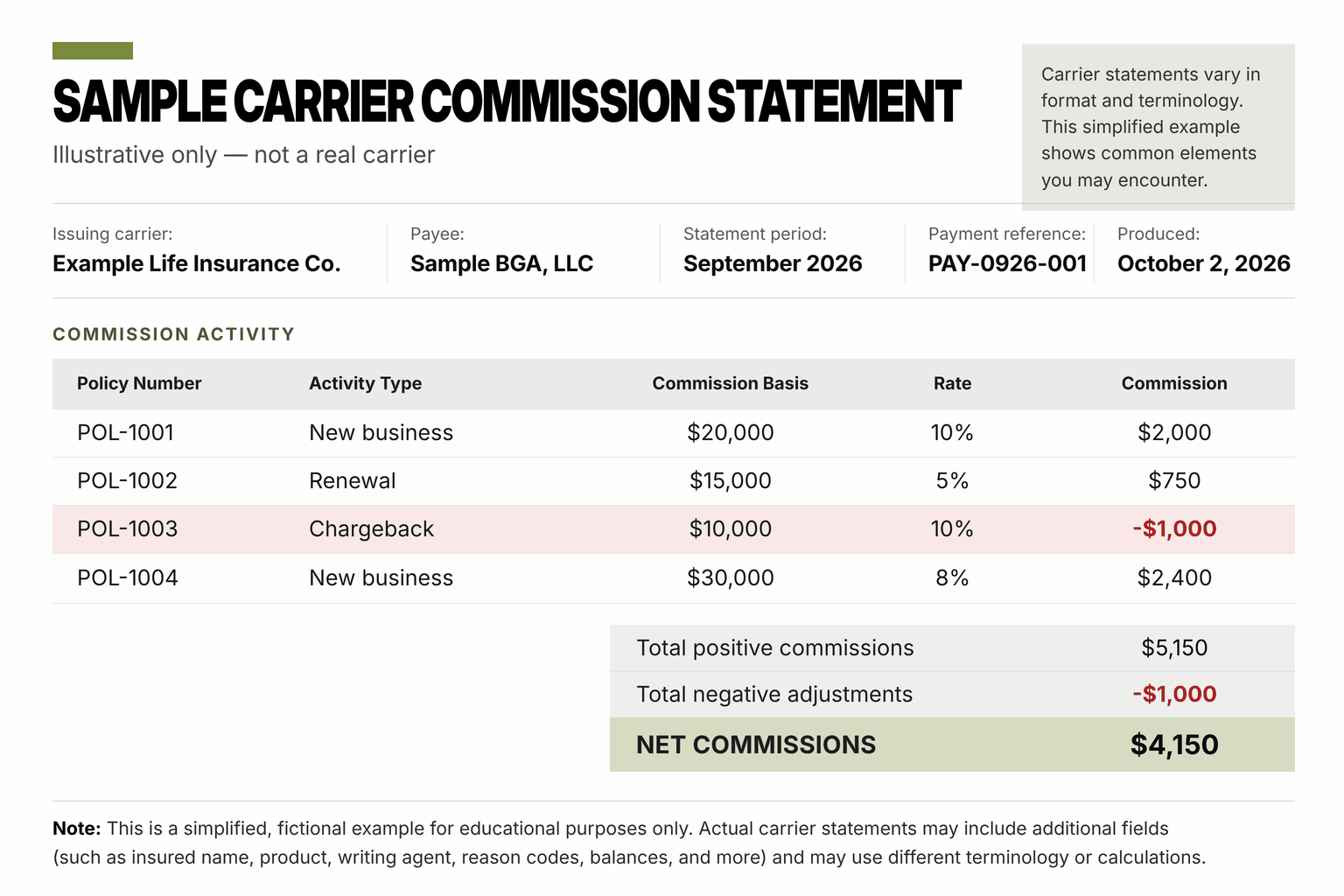
Here’s a sample that we can walk through in detail. Actual carrier statements vary in layout, terminology, commission calculations, and level of detail.
1. Start with the header, not the dollar amount

Before investigating a line item, make sure you have the right statement. Our example identifies Example Life Insurance Co. as the issuer and Sample BGA, LLC as the payee. It covers September 2026, carries payment reference PAY-0926-001, and was produced October 2, 2026.
Each detail does a job. The issuing company tells you which carrier entity reported the activity. The payee tells you which contracted organization is receiving credit. The period and production date help you place the statement in the carrier’s processing cycle. The payment reference can help you investigate the associated settlement.
Don’t assume a September statement contains only September policy anniversaries or September premium activity. Processing dates, payment dates, and policy dates can differ, and their meaning depends on the carrier.
Also, don’t confuse a carrier commission statement, which reports commissions from a carrier to an agency or distributor, with a producer payout statement, which reports compensation paid onward to a writing agent. They document different relationships.
2. Read one commission line all the way across

Look at POL-1001, the first transaction in our example. It reads:
POL-1001 → New business → $20,000 basis → 10% rate → $2,000 commission.
The policy number links the entry to a particular policy. “New business” describes the activity. The basis is the amount on which the example calculation is made; the rate is the percentage applied; and the final figure is what the carrier recorded for that line.
Read these fields as a connected calculation rather than jumping straight to $2,000. If the result looks unexpected, knowing whether the problem lies in the transaction type, basis, rate, or another detail makes the question easier to investigate.
Real statements may include additional columns such as insured name, product, writing agent, effective date, reason codes, and account balances. The field labels may differ between carriers.
3. Check the commission basis and rate
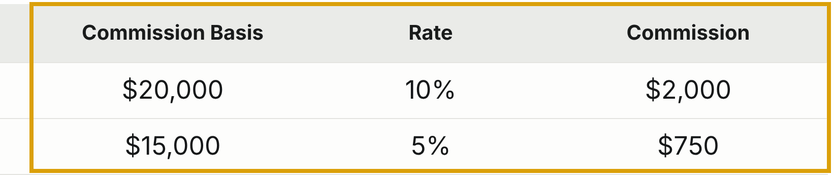
In the example, $20,000 × 10% = $2,000. The arithmetic works. But a mathematically correct line is not necessarily a contractually correct payment.
The commission basis might represent premium received, target premium, an excess-premium component, or another amount defined by the carrier and your agreement. The rate may depend on product, transaction, contract terms, or other factors. Industry documentation from DTCC recognizes distinct commission concepts such as target and excess, splits, and overrides.
Suppose your records indicate that POL-1001 should have earned 12% on the same $20,000 basis. The expected amount would be $2,400, compared with the $2,000 shown. That’s a potential $400 discrepancy, not proof of underpayment. You still need to confirm the agreement, effective dates, and any relevant conditions.
That’s the key distinction: the statement shows what was calculated; your records help establish what should have been calculated.
4. Understand a negative commission line

Now look at POL-1003. The statement shows a −$1,000 chargeback, calculated in our simplified example from a $10,000 basis and a 10% rate.
A negative entry isn’t automatically a mistake. Depending on the carrier and agreement, it might reflect a lapse, cancellation, returned premium, reversal of an advance, or correction to an earlier entry.
The number by itself doesn’t explain the reason. To investigate it, identify the original policy and transaction, find the event that triggered the adjustment, and check the applicable chargeback terms. Some carrier data includes reason codes; other formats may require a separate lookup or communication with the carrier.
Our sample deliberately omits a reason code. You can verify the subtraction from the statement, but you cannot determine whether the chargeback is justified from this example alone.
5. Read the total—and understand its limits
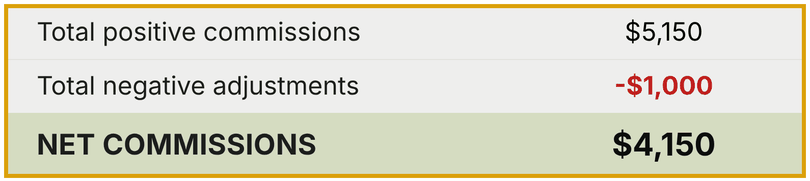
Our example has three positive commission lines: $2,000 + $750 + $2,400 = $5,150. After the −$1,000 chargeback, the net commission total is $4,150.
That confirms how the example’s total was assembled. It doesn’t prove that every expected policy is represented, that the correct rates were applied, or that $4,150 is exactly what arrived in the bank.
Depending on the carrier’s settlement practices, deposits can combine activity across statements or reflect additional adjustments. To verify the money received, use payment and deposit records alongside the statement rather than assuming every statement corresponds one-to-one with a bank transaction.
For a fuller process, see our guide to commission reconciliation for BGAs.
6. When something doesn’t match, document the question
A statement becomes more useful when it helps your team ask a specific question. Instead of writing “POL-1001 looks low,” document what you know:
- Policy: POL-1001
- Statement: September 2026, PAY-0926-001
- Carrier-reported result: $20,000 basis × 10% = $2,000
- Expected result, subject to verification: $20,000 basis × 12% = $2,400
- Question to resolve: Which contract rate applied to this policy and transaction, and on what effective date?
Now you’ve turned a suspicion into an issue that someone can investigate, assign, and close. If the contract confirms 10%, you can clear the item. If it confirms 12% with no other applicable adjustment, you have a documented discrepancy to raise with the carrier.
What makes this worth the trouble is that an underpaid commission never announces itself — it just looks like a slightly smaller number. Nothing bounces, nobody calls, and the $400 difference on POL-1001 quietly becomes what you believe that policy earned. If the problem sits in the contracted rate rather than a one-off keying error, it isn’t confined to this policy, because the same rate governs every other policy and transaction written under that contract. And anything you pay your writing agents off that figure carries the error downstream into their compensation.
And that was the friendly version: four lines, one carrier, every figure sitting right where you could see it. A real month means a stack of these from a dozen carriers who each decided their own layout was the sensible one.
You don’t need every field memorized to read a commission statement well. You need to know what each field tells you, what it doesn’t tell you, and which record can settle the difference.
Make carrier statements easier to work with (or skip all of this entirely)
When every carrier uses its own format, even straightforward questions take longer than they should. GreenWave Commissions helps teams manage carrier commission data and investigate discrepancies with a lot less of the line-by-line work you just did, so the only statements anyone reads this closely are the ones actually worth the argument.
Book a call to discuss the challenges your team runs into when reviewing and reconciling statements.
GreenWave Newsletter
Get practical insights, smarter workflow ideas, and helpful strategies designed to make commission management clearer, more efficient, and easier to control.

Commission Management Secrets
Our concise guide will help you maximize profitability, speed and precision in your business’ commission management process.