
Your Producer Moved Uplines. Can You Still Explain Their Renewals?
Automate Your Commission Process
GreenWave Newsletter
Smarter strategies to simplify commissions, eliminate errors, and stay in control.
Commission Management Secrets
Find $100K+ Hiding in Your Commission Process.
When a producer moves to a new upline, their renewals can change. The policies are the same, but the commission level above them isn’t, and the carrier pays based on the new arrangement. Agencies often find out about a year later, when the producer calls to ask why a renewal check is smaller. By then, nobody remembers exactly what the old arrangement was.
There’s a second version of this problem that’s harder to catch.
An agency asks a carrier to appoint a producer at a certain level, and the carrier sets them up at a different level or under a different hierarchy. The carrier doesn’t tell the agency, so the difference only shows up when the payments do.
Below is how a hierarchy change affects renewals, plus a short checklist for before the move takes effect.
How a hierarchy change affects renewals
One carrier’s agent portal states that a downline’s commission levels must not be greater than the new upline’s. The portal says this applies to renewals as well as new business.
Here’s an illustrative example with made-up numbers. A producer writes a policy while they sit at a commission level of 110 under their current upline. Later, they move to a new upline whose own level is 105. Under the rule above, the producer’s level on that carrier’s business is now capped at 105. That cap includes the policy they wrote while their arrangement supported 110.
The policy itself hasn’t changed, but the ceiling above it has. Now imagine the producer has a few hundred in-force policies with that carrier (again, an illustrative number). The difference is no longer small, and each of those policies is a payment someone may ask you to justify.
Why unexplained renewals become a problem
The money is usually the smaller problem. The bigger one is that a question your team could once answer on the spot now has to be reconstructed.
Say the producer believes they’re being shorted, and you can’t show them otherwise on that call. You’re left with two uncomfortable options. You can absorb the difference to make the problem go away, or you can argue with someone whose production you’d rather keep.
Chargebacks raise the same issue. When one lands on business written under an earlier upline, someone has to work out which arrangement it should settle against. The payment records usually show what was paid but never why.
These questions also come up when a carrier audits you or a buyer is doing due diligence. In those conversations, “we believe it was 110, but the hierarchy has changed since then” is not an answer anybody accepts.
I’ve come to believe that we’re not really in the commission business. We’re in the trust business. You have to keep showing producers that you’re doing a good job, otherwise they go and do something else. Being able to give them a clear answer about their check is a big part of that.
Two questions to check separately
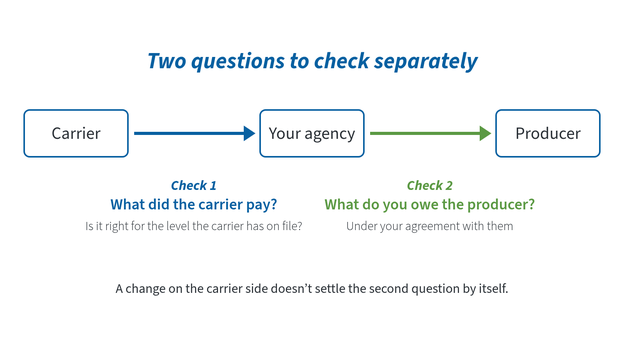
After a hierarchy move, it helps to pull apart two questions that tend to get mixed up:
- What did the carrier pay, and is that correct for the appointment and level the carrier actually has on file? That may not be the one you requested.
- What do you owe the producer under your agreement with them?
A change on the carrier side doesn’t settle the second question by itself. What the producer is owed on business written before the move depends on what you agreed with them. Check incoming and outgoing commissions separately, and write down the answer to each.
How the effective date gets set
A hierarchy change looks like a small administrative step, which is part of why it’s easy to overlook. In the same carrier portal, a change processes within two business days once every signature has been collected.
The signatures are where the timing becomes hard to predict. Only the producer’s current direct upline can start the move, and the incoming upline has to sign and accept it. If a release is involved, it needs to be written permission rather than a verbal agreement.
Carriers act on the paperwork, not on what was agreed during a call. As a result, the effective date lands when the last signature arrives rather than when anyone planned. Any business in flight on that date then falls under rules nobody deliberately chose.
How carriers decide which terms apply
One carrier’s producer guide states that commissions are determined by the application-received date. Every application received on or after the change date is processed under the new terms. The same guide recommends making agent changes before an application is submitted. In practice, an application in flight during the change is governed by the date the carrier logged it, not the date the producer wrote it.
Other carriers may use a different date, so there’s no universal rule to rely on. The practical step is to confirm the dividing date for each carrier in writing before the move. That turns a future disagreement into a quick lookup.
How to keep the old arrangement on record
It’s worth asking what your system keeps when a hierarchy changes. If it overwrites the old arrangement with the new one, the explanation for every earlier payment goes with it.
Later corrections need the same care. Sometimes a change arrives after the fact and is backdated, either by the carrier or through an agreement with the producer. Record that correction as its own dated entry that refers back to the original. Don’t edit the original so it looks as if it had always been that way. Anyone reviewing the account later needs to see what was paid at the time and why it was adjusted.
A checklist for before the effective date
Work through these five steps before the move takes effect:
- Write down the producer’s current hierarchy, including their upline and levels, along with the date you recorded it.
- Compare the appointment and level you requested with what each carrier has actually confirmed on file.
- Record what was agreed for business already written and for business written after the move. Do this for both the carrier side and the producer side.
- List the carriers affected, and note the dividing date each one uses based on that carrier’s own documents.
- Decide how later corrections will be recorded. Each one should be a new dated entry that references the original rather than overwriting it.
Why this is worth an hour before the move
Going through these steps while everything is still fresh takes about an hour. Admittedly, it’s a boring hour. It’s also the difference between answering that producer’s question on the spot a year from now and spending a week rebuilding what your team already knew.
If a producer asked you today why a renewal paid what it paid two years ago, could you show them? If you’re not confident, [link to book a call] and we can look at what your records actually capture.
GreenWave Newsletter
Get practical insights, smarter workflow ideas, and helpful strategies designed to make commission management clearer, more efficient, and easier to control.

Commission Management Secrets
Our concise guide will help you maximize profitability, speed and precision in your business’ commission management process.