
Q4 Planning: Setting Your Commission Process Up for Success
Automate Your Commission Process
Discover how we can help your business save money!
GreenWave Newsletter
Smarter strategies to simplify commissions, eliminate errors, and stay in control.
Commission Management Secrets
Find $100K+ Hiding in Your Commission Process.
September is a funny month in our business. The sales side is warming up for the biggest push of the year. The commission desk is quiet, statements are flowing, and everything feels under control. It is the calm before the busiest 13 weeks your commission team will see all year!
Here’s what most agencies miss:
The quality of your Q4 is decided in SEPTEMBER. Not in November when the statements pile up, and not in January when the 1099s are due.
Right now, while you still have room to fix things.
So let’s use September well.
In this post, I want to give you a simple planning routine built around three questions. If you can answer all three with confidence by the end of the month, your commission process is ready for Q4. If you cannot, you know exactly what to work on.
How Big Q4 Really Is
Every agency principal knows Q4 is busy. Fewer have looked at how lopsided it actually is.
In 2025, individual life insurance new annualized premium in the U.S. reached $17.5 billion, according to LIMRA. Of that, $4.9 billion came in the fourth quarter. That is roughly 28% of the entire year’s premium in a single quarter! Policy count rose 9% in Q4, and indexed universal life set both quarterly and annual records with $1.3 billion in fourth-quarter premium.
The annuity side is even more dramatic. LIMRA reports that fourth-quarter annuity sales jumped 14% to $117.2 billion, the ninth consecutive quarter above $100 billion. Registered index-linked annuities alone hit $22.1 billion in the quarter, up 23%. With roughly 4.1 million Americans turning 65 every year, LIMRA expects demand for these products to stay strong even as the broader economy softens.
Now translate those numbers to your commission desk. More policies means more carrier statements. More statements means more lines to reconcile. More first-year commission means more validation, and more overrides flowing up the hierarchy to every level that gets paid. Every rider, every face amount increase, every mode change, every direct bill policy that used to be list bill, all of it shows up MORE in Q4, because there is more of everything.
Your process does not get a pass because it is busy. The agents still want their money on time, and correctly!
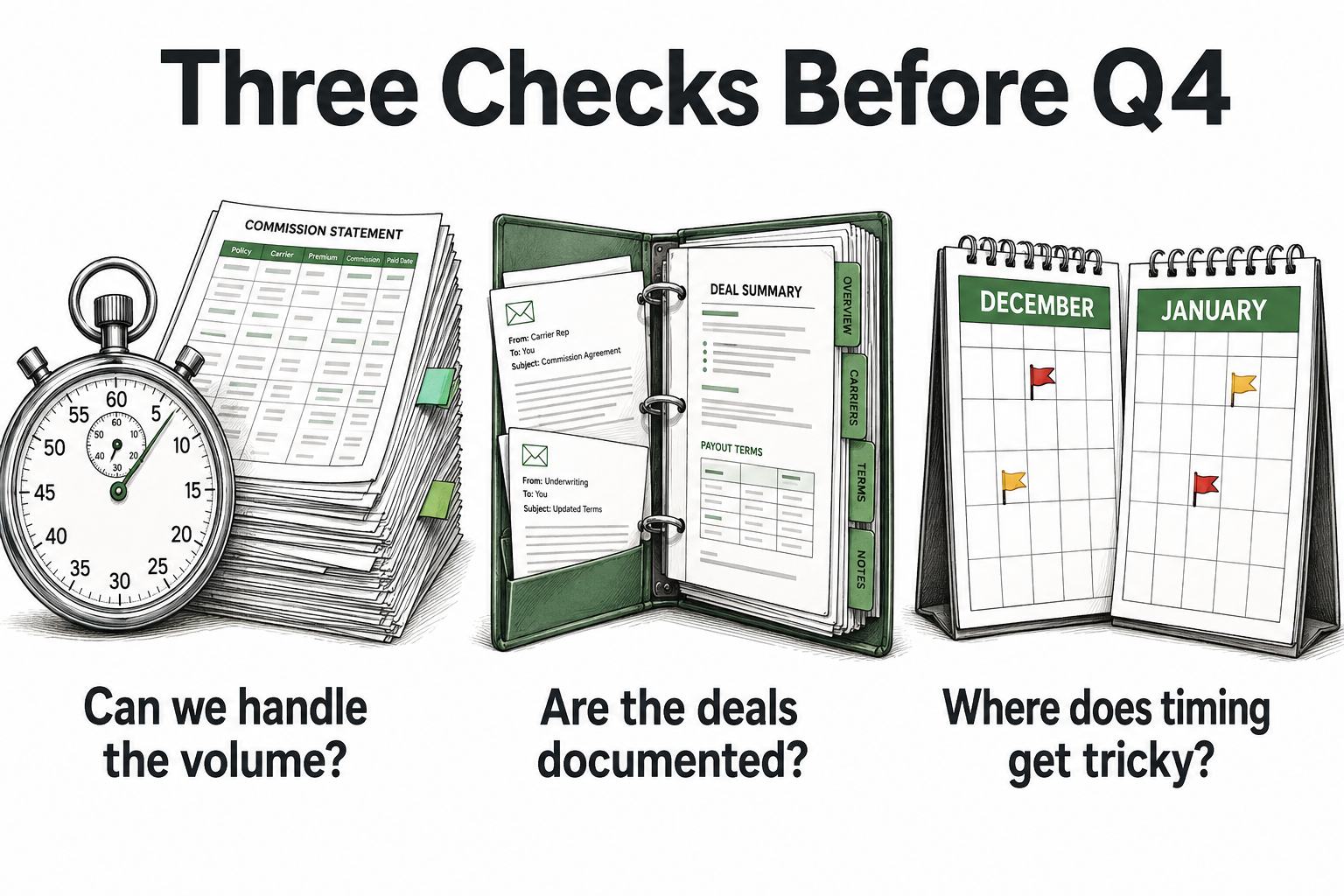
Question 1: Can our process handle the spike?
The honest way to answer this is not to guess. It is to TEST.
Here is a September exercise I recommend to every agency.
Pick the three to five carriers that gave you the most trouble last Q4. You know which ones they are. The ones with the most held lines, the most calls to carrier support, the most “we will fix it on the next statement” conversations. Pull last year’s fourth-quarter statements from those carriers and run them through your current process, start to finish. Time it.
If your team can clear a heavy Q4 week for your hardest carriers in the time they actually have, congratulations, you are in good shape. If they cannot, you have just found your September project. And notice what kind of project it is. It is a process fix or a software fix first. Hiring comes later, and I will get to that.
The beauty of this test is that it uses real data from your own agency. No assumptions, no hoping. You will know.
Question 2: Are the deals we will pay on documented and up to date?
Q4 reconciliation becomes detective work when the paperwork behind the numbers is out of date. Carriers update schedules during the year and do not always make a lot of noise about it. Producers negotiate special arrangements over the summer that live in someone’s email. Downline agencies come on board with override deals that were agreed on a phone call.
September is the month to refresh all of it. Every carrier schedule you will pay on in Q4. Every producer deal. Every hierarchy and every override level. Write it down in one place, in the exact names your agency management system uses, so that when a statement line comes in at an unexpected rate, your team can tell in seconds whether the carrier is wrong or your records are.
This is not glamorous work. But it is the difference between a Q4 where reconciliation takes hours and a Q4 where it takes weeks.
Better documentation, better reconciliation, better Q4!
Question 3: Where will the year boundary trip us?
The end of the calendar year creates a handful of traps that only show up once a year, which is exactly why teams forget them. Let’s walk through them.
Effectuation timing. A policy applied in December and effectuated in January pays in January. The producer sold it in December and expects December money. Your revenue lands in the new year. Nobody is wrong, but everybody needs to know the rule ahead of time, and your producers should hear it from you in October, not from a short statement in February.
First-year commission and chargebacks. The big first-year commission from Q4 business arrives on Q1 statements. So do the first chargebacks on early lapses from the same wave of business. If your process handles these on separate tracks, Q1 becomes a mess of adjustments. Plan for them to arrive together.
Annual production bonuses. If you pay bonuses on full-year KPIs, you need clean year-to-date production data by mid-December. Not mid-January. The data cutoff for bonuses is a decision, and it should be made and communicated in September.
1099-NEC season. Form 1099-NEC must be filed with the IRS and furnished to each producer by January 31, and there is no automatic extension. That date is fixed. If your December records are clean, January is easy. If they are not, you will spend the first month of the new year cleaning them up under deadline pressure. One more thing to check with your accountant this fall: the reporting threshold for 1099-NEC changed for payments made in 2026, so confirm who on your producer list needs a form under the new rules.
Why spreadsheets fail at exactly this moment
Many agencies run commissions in Excel and do it well, most of the time. The question for Q4 is what “most of the time” means at the highest volume of the year.
Raymond Panko at the University of Hawaii has spent decades studying spreadsheet errors, and his findings are worth a minute of your attention. In field audits of real operational spreadsheets, the large majority contained errors. More interesting to me is the confidence finding. When people building spreadsheets were asked to estimate the chance their work contained an error, the average guess was 18%. The actual rate was 86%.
That gap is the Q4 problem in one number. A process that works at normal volume because a sharp commission manager catches the mistakes does not automatically work at 28% of annual premium in one quarter, because catching does not scale the way volume does. Confidence in September is not the same thing as capacity in November.
And the errors that slip through are not small. Our own analysis at GreenWave, across the $6.4 billion in commissions we process every year, found commission errors averaging 18.3% of revenue, and in the last couple of years that number has climbed past 20%.
Staffing: process, then software, then people
When a commission team feels strained, the instinct is to add a person. I understand the instinct, and sometimes it is right. But the ORDER matters.
First, ask whether the process can be made more effective. The load test from question one will usually point to two or three steps that eat most of the time. Fix those.
Bill Gates put it best:
“The first rule of any technology used in a business is that automation applied to an efficient operation will magnify the efficiency. The second is that automation applied to an inefficient operation will magnify the inefficiency.”
That is the whole reason process comes before software in this list.
Second, ask whether the software can carry more of the work. Automated statement collection, line-by-line validation against your documented schedules, bonus calculation on KPIs the system already tracks. This is what a system like GreenWave is built to do, and it is the reason a well-built agency can grow its volume without growing its commission team at the same rate.
Third, ask whether it is time to add headcount. And know that more people can make things WORSE. Outsource your statement checking to 400 people at $3 an hour and you’ve really just created 400 new sources of variation applying a process nobody wrote down. People scale effort, but only process scales accuracy.
Be realistic about timing too. A person hired in October is still learning in December. If your team is strained in September, the December fix is process and software. The hiring decision belongs to next year, and this Q4 will give you the real data to make the right choices moving forward.
What to fix in September, and what to leave alone
Do not try to do everything. That is how September projects turn into November emergencies.
Fix three things now.
- Run the load test on your hardest carriers and repair what it exposes.
- Refresh your schedules and producer deals.
- Set and communicate the bonus data cutoff.
Leave two things for January. New carrier buildouts can wait, unless the carrier is one of your load test problems. Reporting and dashboard projects can wait. They are valuable, but they are not the thing standing between your team and a smooth Q4.
Why leave it to chance?
Q4 is coming whether your commission process is ready or not. The sales team will do their part. The carriers will send their statements. The producers will expect to be paid correctly and on time, because that is what they always expect, and they are right to.
The only variable you control is whether you planned. Three questions, one month, a highly effective commission process ready for the biggest quarter of the year.
Happy planning, and happy Q4!
GreenWave Newsletter
Get practical insights, smarter workflow ideas, and helpful strategies designed to make commission management clearer, more efficient, and easier to control.

Commission Management Secrets
Our concise guide will help you maximize profitability, speed and precision in your business’ commission management process.