
Why A Renewal Commission Changes From One Policy Year To The Next
Automate Your Commission Process
GreenWave Newsletter
Smarter strategies to simplify commissions, eliminate errors, and stay in control.
Commission Management Secrets
Find $100K+ Hiding in Your Commission Process.
Nothing wrecks an afternoon quite like a producer who is convinced he’s been shorted. He’s looking at a policy he wrote four years ago, the renewal came in lower this year than last, and he wants to know where the rest of it went.
The honest answer is that it usually went nowhere.
Renewal amounts move between policy years for reasons the agreement already accounts for, and the work in front of you is less an investigation than a matter of working out which thing moved.
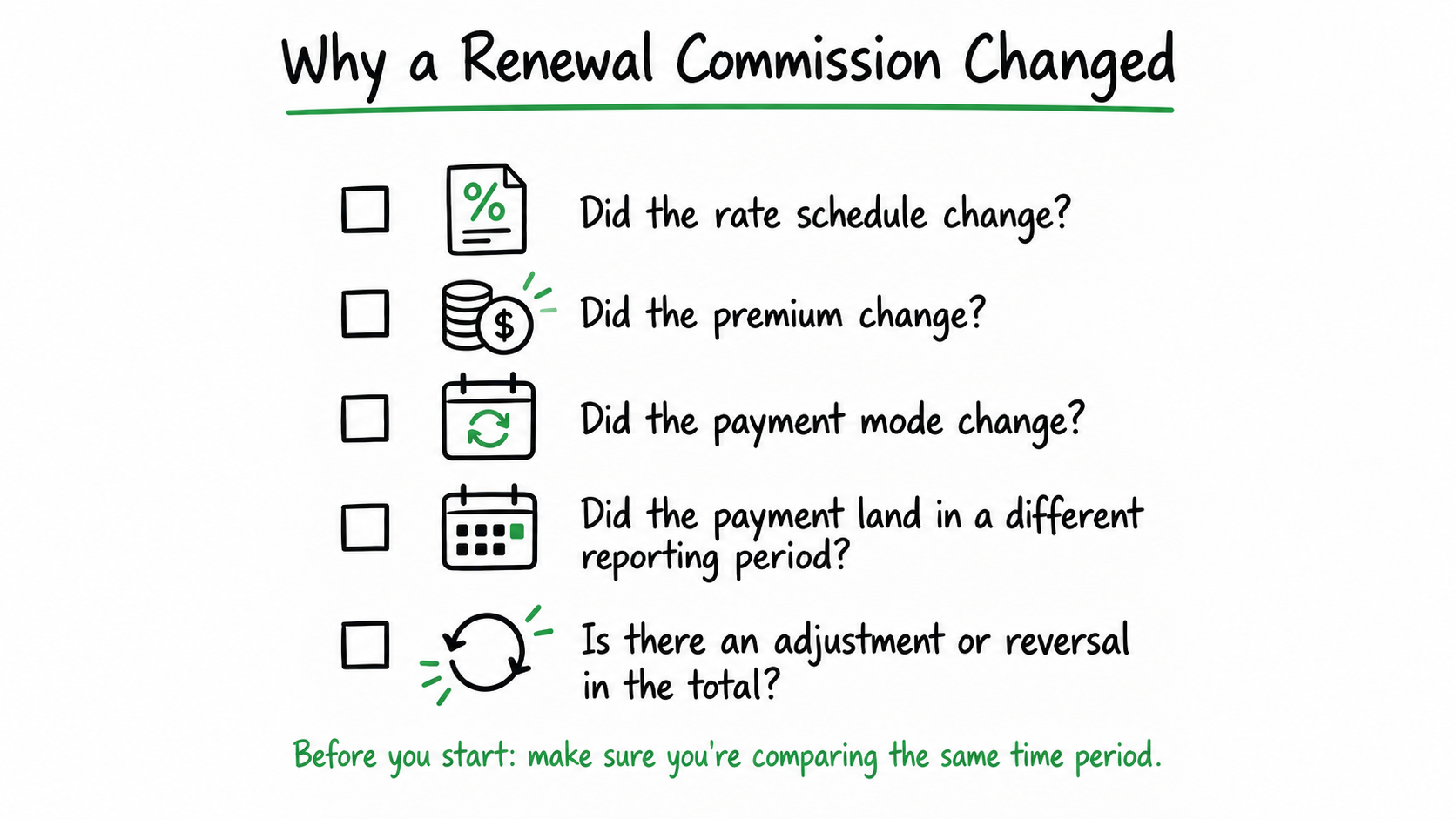
Five questions will normally settle it, and every one of them can be answered from records you already hold.
Before any of them, make sure the two policy years you’re comparing cover the same span of time. If one holds twelve months of applied premium and the other holds nine so far, you’ve found a gap in your comparison rather than a gap in the commission.
Did the schedule set a different rate for this policy year?
Start here, because it’s the most common answer and the one most often skipped — the rate showing in the portal today is right there and easy to copy.
A renewal rate can differ from one policy year to the next under the agreement that governed the policy when it was written, and how it differs depends on the product, the carrier, and the contract, so there’s nothing worth generalizing from one policy to another. What’s worth seeing is how explicit these schedules get: one selling agreement filed with the SEC sets out compensation year by year, with the percentage stepping down as the contract ages and changing again past a certain year.
To check: pull the agreement and the schedule version in force for that policy, then read the row for the policy year in question rather than the current one.
Did the premium underneath the rate move?
The rate can hold perfectly steady while the base it applies to moves. A rider came off, coverage was adjusted, a face amount changed, and the commission follows the premium down without anyone touching a rate.
Look at the commission-eligible premium as well as the premium paid, because some arrangements exclude certain components from the commissionable amount and the two figures aren’t always the same number.
To check: compare the premium applied in each period, and the eligible portion of it, against the policy record.
Did the payment mode change?
A switch from annual to monthly does two things at once. The total premium paid across a year varies by payment mode, which carriers explain on their own policy pages, and premium that used to arrive in a single payment now arrives in twelve, so the commission reports across many more cycles than it used to.
Inside one statement period that reads as a drop, though measured across the full policy year it often isn’t one.
To check: read the mode on the policy record for each of the two years, then total the commission across the year rather than per statement.
Did the payment land in a different reporting period?
Premium applied close to a policy year boundary can be reported on a statement that falls in the next one, so nothing was lost and the boundary simply sits somewhere other than where you assumed when you pulled the two years.
Statements carry more of this detail than people expect. One life carrier’s guide to its commission statement ties every entry to the certificate year the premium was applied to and the schedule rate the commission was based on. Field names vary by carrier, but the underlying facts are usually in there somewhere.
To check: compare the date the premium was applied against the statement period it was reported in, and look one period either side of the gap.
Is an adjustment sitting inside the total?
A reversal or a correction on earlier business can be netted into the period total, which makes the renewal look smaller than the policy actually earned.
Most statements code these separately from regular commission entries, which is the useful part, and a negative sign on its own establishes nothing. An adjustment explains your gap only when the records connect it to the payment you’re asking about.
To check: find the separately coded adjustment, reversal, or chargeback entries in the period and trace each one back to the business it relates to.
When all five come back with “no”
That’s when the carrier hears from you, and by then you can write a far better message than you could have an hour earlier. Name the policy and the period, say which schedule you read and what premium you confirmed, then state the single input you couldn’t establish. A question that specific tends to come back with something usable, where “please review this renewal” buys another cycle of waiting.
Either way, the answer belongs with the policy. A renewal question settled once shouldn’t need settling again next year by whoever happens to pick up the call.
Why this takes longer than it should
None of these checks is difficult; what makes them slow is that the schedule, the policy record, and the transaction usually live in three different places, so a comparison that should take minutes turns into a morning of switching between systems.
Making that comparison quick is what commission management software is for. GreenWave keeps carrier commission schedules and the transactions they apply to in the same system, so both policy years can be read in one place.
Book a call with GreenWave and we’ll walk through a renewal question your team is working on now, using your own schedules and statements.
GreenWave Newsletter
Get practical insights, smarter workflow ideas, and helpful strategies designed to make commission management clearer, more efficient, and easier to control.

Commission Management Secrets
Our concise guide will help you maximize profitability, speed and precision in your business’ commission management process.