
Stop “Handling” Year-End Commissions. Start Controlling Them
Automate Your Commission Process
GreenWave Newsletter
Commission Management Secrets
Find $100K+ Hiding in Your Commission Process.
Fast forward to December 28.
Imagine one of your top producers just crossed his production threshold with three days to spare. He’s celebrating!
But you know who isn’t?
Your commission manager. That’s because that milestone bumped his split, and now every payout he earned this quarter has to be recalculated retroactively, in the week between Christmas and New Year’s – by somebody who would rather be anywhere else.
Welcome to year-end in the insurance business.
Agents shove everything they can through the pipeline because bonuses, contingent commissions, and the trip to Europe all get decided by December 31. That pressure produces napkin deals, special arrangements, and applications written in a hurry to be cleaned up later. More commission mistakes are made in December than in any other month of the year, and every one of those mistakes is money walking out of your agency while you are at a holiday party.
Most owners treat this like weather. They brace for it, suffer through it, and mop up in January.
I’m telling you that is a choice, and an expensive one. December chaos has five specific causes.
Control them and December becomes a great month on your calendar. Ignore them and you pay for the same chaos every single year, forever.
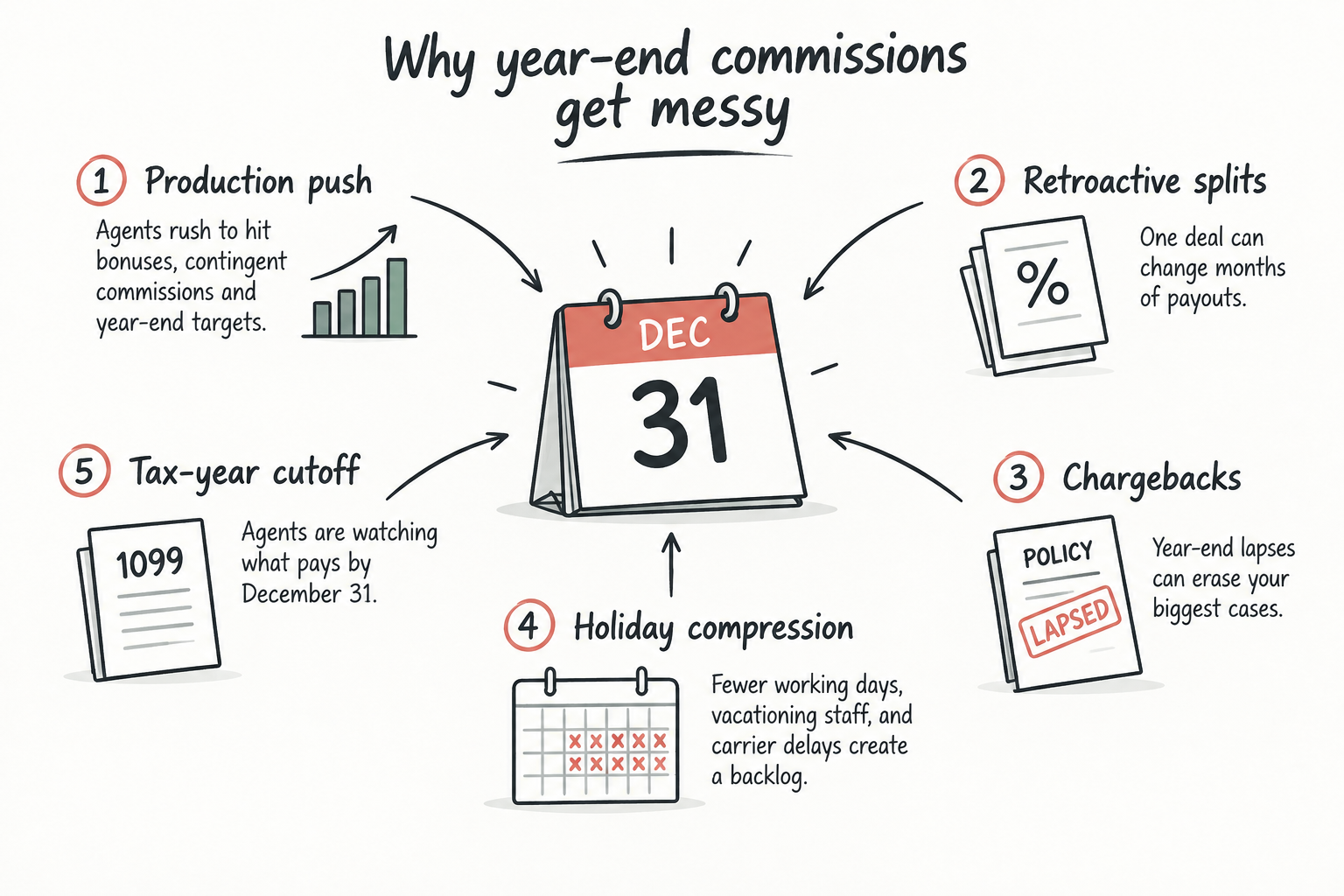
1. Everyone is chasing a December 31 number
Your agents did not create year-end volume out of the blue. Contingent commissions, matching bonuses, production clubs, and incentive trips all hinge on what gets placed before December 31, so they will drag every last case across the line. The whole industry runs this way. LIMRA reported fourth quarter annuity sales of $117.2 billion, up 14%, the ninth straight quarter above $100 billion (LIMRA).
A sales force sprinting at year-end is a gift. Owners who complain about December volume are complaining about revenue. But your problem was never the volume. Your problem is a commission process held together by spreadsheets and the memory of one overworked person.
The rule: know every bonus threshold and every agent’s position against it by December 1. Nothing that lands in the final week should surprise anyone in your office.
2. Graduated splits that reach backward and grab your money
Many comp plans bump an agent’s percentage at a premium milestone, and some bumps apply retroactively. One case placed December 28 changes the correct payout on months of earlier business. By hand, that is hours of look-back math per agent, done by tired people during the holidays.
Get it wrong in one direction and you overpay. That money is gone, and you will never see it again. Get it wrong in the other direction and your best producer starts January convinced you shorted him. Both outcomes came out of your pocket.
The rule: every split, tier, and effective date lives in the system, in writing, and the recalculation fires automatically the moment a threshold is crossed. No human math on deadline.
3. Chargebacks aimed at your biggest cases
Year-end is when clients review budgets and shop their coverage, which makes it prime lapse season. The SOA and LIMRA studied 33.5 million policy-years of universal life exposure and counted 1.3 million lapse terminations (SOA Research Institute). Policies fall off the books constantly, and when a December case lapses, the chargeback lands on the largest, most rushed business you wrote all year. If you advanced commission on it, you are now chasing an agent for money he already spent on Christmas.
The rule: every advance is tracked to its policy, and chargebacks net against future payouts automatically. The system collects your money so you never have to make that phone call.
4. Fifteen working days to do the work of forty
December hands you the biggest translation volume of the year and takes away a week of holidays, your vacationing staff, and carriers who close their books and send statements late or loaded with adjustments. Every error that slips through in December resurfaces in January as a dispute, and disputes cost you twice: once in the money, again in the hours your team burns arguing about it.
The rule: staff January as a reconciliation month on purpose. Agencies that plan the cleanup finish in days. Agencies that get ambushed by it fight with producers into March.
5. Your agents are watching their tax year close
Every 1099 producer knows his tax bill rides on what actually pays out by December 31. The IRS counts income in the year it is received or made available, not the year it was earned (IRS Publication 538). So in late December your agents track every pending payment like hawks, and your commission desk fields a call about each one. A payment slipping from December 30 to January 2 moved a person’s income into a different tax year – they’re not going to be casual about it!
The rule: publish your December payment cutoff in November, tell every agent exactly which business pays this year, and hold the line. Certainty kills those calls before the phone rings.
You need a system, not another spreadsheet
Notice what all five of these problems have in common.
None of them are solved by asking your commission team to be more careful. You need the thresholds tracked, the split changes applied, the chargebacks recovered, the payment cutoffs followed, and the exceptions documented every single time — especially when December gets busy.
That requires more than a list of rules. It requires a system that enforces them.
And that is where spreadsheets fall apart.
Spreadsheets are good at calculating commissions. They are bad at enforcing them. A formula can tell you what should happen, but it cannot make sure the right deal was entered, the right threshold was applied, or the exception was handled consistently.
A rule that lives in someone’s head is a preference – and preferences collapse in December.
You need a commission system that enforces the rules.
A commission system does not care what month it is. Every cause on this list that wrecks a manual commission operation barely registers in an automated one.
With splits, thresholds, advances, and chargebacks configured in a real commission system, your agents can write as much December business as they can physically sign, and the right numbers simply happen while your commission manager reviews exceptions instead of rebuilding spreadsheets at 9 p.m.
Agencies that run this way do not dread December. They cheer for it.
If your team is bracing for year-end instead of rooting for it, we should talk! Bring your comp plan. We will show you exactly where December is going to bite you and how to take the teeth out before it does.
P.S. The agencies that fix this before Thanksgiving get a calm December and a clean January. The ones that wait until the first dispute lands try to fix it in March, after the money is already gone.
GreenWave Newsletter
Get practical insights, smarter workflow ideas, and helpful strategies designed to make commission management clearer, more efficient, and easier to control.

Commission Management Secrets
Our concise guide will help you maximize profitability, speed and precision in your business’ commission management process.